麻豆精选

Visiting Artist Simon Ungless Explores Sustainable Design With 麻豆精选Students

The renowned designer, educator and printmaker shared lessons from 35 years in fashion, including his influential early collaboration with Alexander McQueen, during a five-day residency at Kent State.

As part of Kent State鈥檚 ongoing Thomas Schroth Visiting Artist Series, the university hosted designer and printmaker Simon Ungless and his partner, Jody Niederkohr, from Sept. 14-18, kicking off the 2026-27 series. Their visit included three silk-screen workshops with 45 麻豆精选students and faculty in the Design Innovation Hub鈥檚 Reactor Makerspace, classroom visits and a free public presentation with question-and-answer session exploring the intersection of fashion, printmaking and sustainable design.

Working With What Is Already There

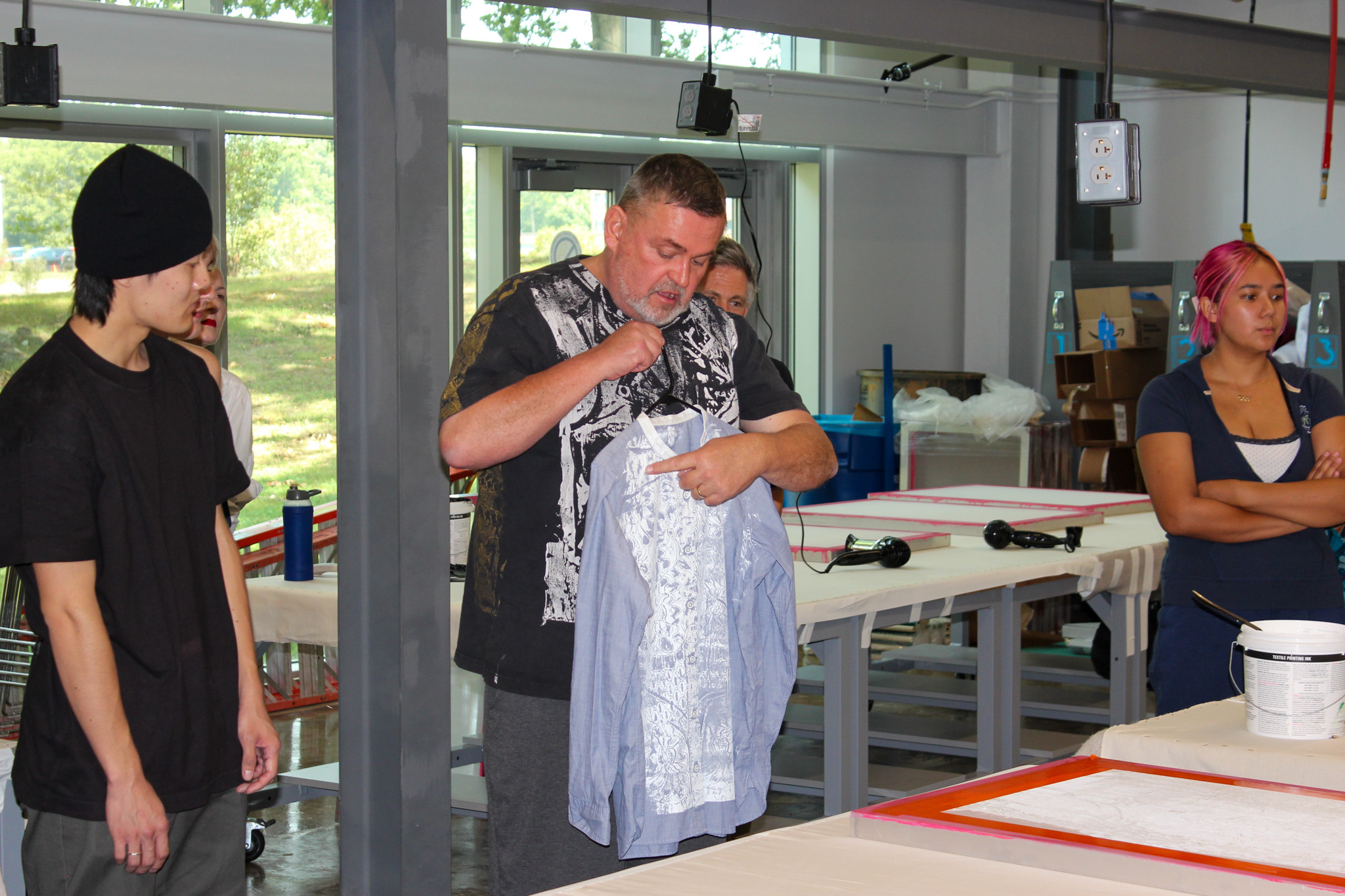
During the workshops, 麻豆精选students watched closely as each garment was lifted from the screen and its final pattern was revealed. The patterns came from the unique texture of another piece of clothing. One garment creates an impression in ink that is then transferred onto another.

Working alongside Ungless and Niederkohr, students used the technique to create one-of-a-kind designs while considering the possibilities held within existing clothing. No one knew exactly what each print would look like until it came off the screen, and many were excited by the results.

School of Fashion Professor Joanne Arnett, who helped organize the residency, said working with their own garments made sustainable design immediately accessible to students and moved it from theory to practice.

鈥淭he process rewarded fearlessness,鈥� Arnett said. The speed of the process also encouraged students to try ideas, embrace unexpected results and move beyond a fixed vision for the final design. 

A Philosophy Built Over Decades

For Ungless, working with what already exists rather than starting from scratch is not a recent shift. During his public presentation, he described his early years designing alongside his close friend, the late Lee Alexander McQueen. Ungless told students he has always worked to bring fashion and textiles together. One example was a screen-printed shower curtain transformed into a dress that was later worn by Naomi Campbell.

That instinct carried into When Simon Met Ralph, the design house Ungless now runs with Niederkohr, his husband and business partner. Ungless shared that sustainability was an area he wants to make changes in, especially how consumers think about clothing, including where it comes from, who made it and what they already own. 鈥淲e don鈥檛 always need to go to the store and buy something,鈥� he said. 鈥淲e can use what we already own.鈥�

At When Simon Met Ralph, previously worn garments are faded, dyed or reprinted into something new. There are no size ranges and no two pieces are alike, a detail Ungless said suppliers still struggle to grasp. Much of the pair鈥檚 current work begins with garments people bring from their own closets. It is a working, still-evolving practice, and for five days, 麻豆精选students got to work inside it rather than simply hear about it.

 

Why Ungless and Niederkohr

School of Fashion Professor Archana Mehta said Ungless and Niederkohr were invited to 麻豆精选because their approach could introduce students to techniques that give existing garments new life or add dimension to their original designs. 鈥淲e knew having access to a designer like Simon, whose work is so influential, would be inspiring,鈥� she said.

The goal went beyond teaching a new technique. Mehta said she hopes students gained a greater sense of play and experimentation, along with a better understanding of collaboration from working together during the workshops.

In His Own Words

During his presentation, Ungless emphasized the importance of technical skills, including drawing, sketching and creating flats. He also encouraged students to generate their own ideas and inspiration. 鈥淵ou have to be able to self-generate,鈥� he told them.

The public question-and-answer session gave students a chance to ask Ungless directly about the ideas behind his work. 鈥淧eople are looking for things that are touched by human hands,鈥� he told the DI Hub audience. 鈥淧eople want to know who is making their clothing and where it鈥檚 coming from.鈥�

When asked how he would approach his career if he were starting over today, Ungless said he would not change much. 鈥淢aking something out of nothing. We do that now,鈥� he said. 鈥淥ne of the best challenges and exercises is to do things with your hands. You don鈥檛 have to have everything, or even anything. You can make things.鈥�

Speaking about Kent State, Ungless told students, 鈥淵ou鈥檙e in the right place. You made a good choice.鈥� He also encouraged them to recognize the value of the people around them. 鈥淭he people who are in class with you, that is your network,鈥� he said. 鈥淵our classmates become your greatest resource. Pal up and do projects together. You never know where it will end up.鈥�

He left the audience with an assignment: 鈥淜eep spreading the message that you don鈥檛 always have to buy new.鈥�

On View Through Oct. 1

Work created during the workshops is on display in the DI Hub Gallery through Oct. 1. Mehta said she hopes the exhibition changes how visitors think about their own closets. 鈥淲e hope that visitors can see the possibilities of how the garments in their closet can be refashioned and renewed and that they can shop their own closets instead of succumbing to fast fashion.鈥�

School of Fashion Professor Sue Hershberger Yoder expects the effects of the residency to outlast the exhibition itself. 鈥淲e think students will approach creativity with confidence and feel inspired to create bold and exciting work,鈥� she said.

Learn more about the Thomas Schroth Visiting Artist Series 

POSTED: Thursday, September 24, 2026 10:47 AM
Updated: Thursday, September 24, 2026 12:32 PM
WRITTEN BY:
Jen Crabtree