
What happens when mechanical forces act on the molecules that make up living systems? How do those forces change the way molecules interact, alter chemical reactions, or influence the behavior of cells?
These are some of the questions driving research in the group of Dr. Hanbin Mao in 麻豆精选鈥檚 Department of Chemistry and Biochemistry. Working at the intersection of chemistry, biology, engineering, microscopy, spectroscopy, and instrumentation, the Mao research team investigates biological systems at the molecular 鈥� and even single-molecule 鈥� level.
The group鈥檚 interdisciplinary research spans single-molecule biophysics, DNA nanotechnology, molecular interactions, mechanoanalytical chemistry, and cell and molecular biology. A central focus is understanding how mechanical forces, including stretching, pulling, compression, and shear stress, can influence molecular structures, chemical reactions, and biological processes.
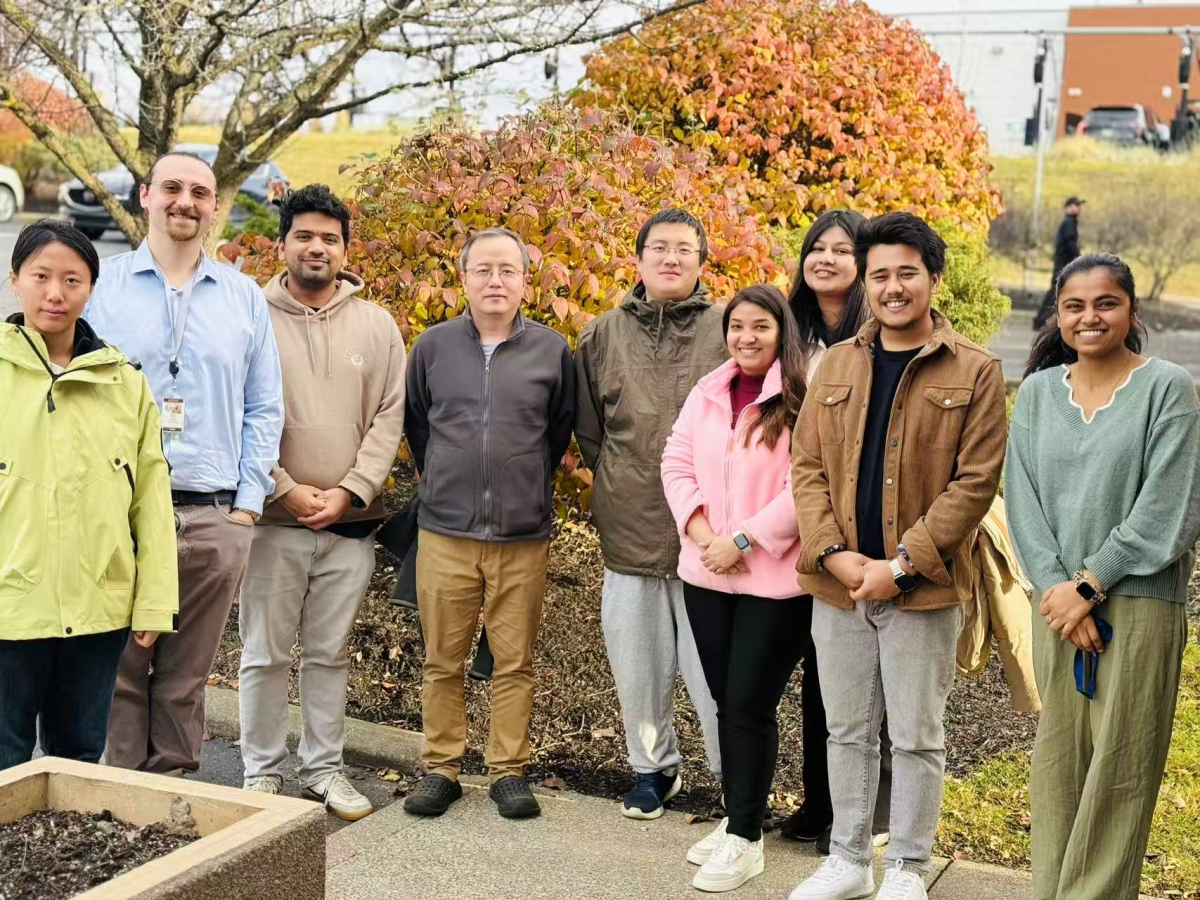
Members of the Mao research group.
Investigating Chemistry Under Force
Mechanical forces are an often-overlooked component of chemistry and biology. Molecules do not exist in isolation. Within cells and biological systems, they are constantly being pushed, pulled, bent, and otherwise subjected to physical forces.
Mao鈥檚 group develops analytical approaches allowing researchers to investigate what happens to molecules when those forces are applied. By measuring force-dependent changes in molecular interactions, structures, and reactions, the researchers can gain insight into how mechanical forces regulate processes such as cell adhesion, signaling, and cellular behavior. This work is part of the group鈥檚 broader focus on mechanoanalytical chemistry: using analytical chemistry to understand chemical and biological processes influenced by mechanical forces.
When asked about his initial interest in mechanoanalytical chemistry, Dr. Mao described it as stemming from a fundamental curiosity shared by many chemists: recognizing that molecules within living systems are never truly at rest.
鈥淭hey are constantly being pushed, pulled, twisted, and compressed,鈥� he said, 鈥渂y neighboring molecules, by cellular machinery, by the physical demands of life itself. What drew me deeper into this area was the recognition that force is not merely a perturbation to biological systems 鈥� it is often a signal.鈥�
鈥淢echanical forces can trigger conformational changes, alter reaction rates, and fundamentally reshape how molecules interact. Understanding that layer of biology requires tools and frameworks that sit uncomfortably within any single discipline, which is exactly what makes it so compelling.鈥�
Seeing One Molecule at a Time
Many conventional experiments measure the average behavior of millions or billions of molecules at once. Although these measurements provide valuable information, averaging can obscure important differences between individual molecules.
Single molecule techniques offer a different perspective.
By observing individual molecules, researchers can investigate molecular interactions, conformational changes, binding events, and reaction pathways as they happen. These experiments can reveal details about molecular behavior that may be hidden in conventional bulk measurements.
The Mao group combines advanced microscopic and spectroscopic approaches with sophisticated instrumentation to make these measurements possible.
One recent example of this is the group鈥檚 work on mechanozymes, artificial enzymes whose activity can be influenced by mechanical force. In a 2026 paper published in Advanced Science, Mao and colleagues demonstrated that applying mechanical force to a DNA-based artificial enzyme could alter its structural stability and catalytic activity. Using single-molecule fluorescence measurements, the researchers examined the behavior of individual artificial enzymes and showed how mechanical force could modulate their activity.
The work illustrates the unusual questions that can be addressed when chemistry is studied at the single-molecule level: rather than simply asking whether a reaction occurs, researchers can investigate how the structure and physical environment of an individual molecule influence its behavior.
Developing New Tools for Discovery
A major component of the group鈥檚 research is the development of new technologies and analytical approaches. The researchers seek to create tools that offer greater sensitivity and precision for investigating molecular interactions and biological processes.
This emphasis on disruptive technologies allows the group to approach longstanding scientific questions in new ways. Their work brings together chemistry and engineering with advanced microscopy, spectroscopy, and instrumentation to develop methods capable of probing biological systems at increasingly smaller scales.
These tools can also open opportunities beyond fundamental research. Understanding how molecular structures respond to mechanical forces could ultimately contribute to new approaches in areas such as biosensing, catalysis, and biomedical research.
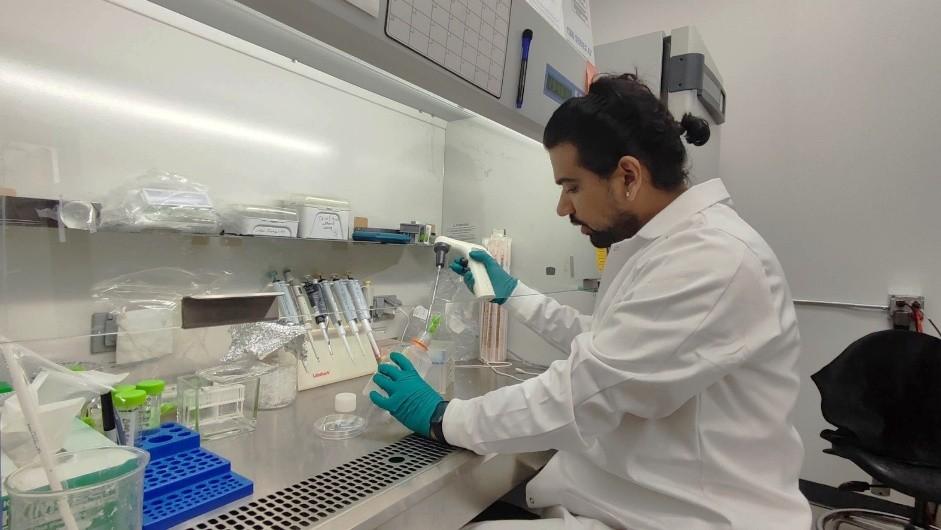
Graduate student Grinsun Sharma prepares mammalian cells for mechanobiology experiments.
Connecting Molecules to Living Systems
The group鈥檚 research also extends from individual molecules to cells and biological systems. Through its work in cell and molecular biology, the team investigates how molecular interactions and structural changes influence larger biological processes.
This creates a continuum that runs from molecules to cells: researchers can examine what happens to an individual molecule under mechanical stress and then consider how molecular-level events contribute to cellular behavior.
That interdisciplinary perspective is central to the research group. Chemistry provides the foundation for understanding molecular interactions and reactions, while biology provides the systems in which those interactions matter. Engineering, microscopy, spectroscopy, and instrumentation provide the tools needed to observe and manipulate these processes.
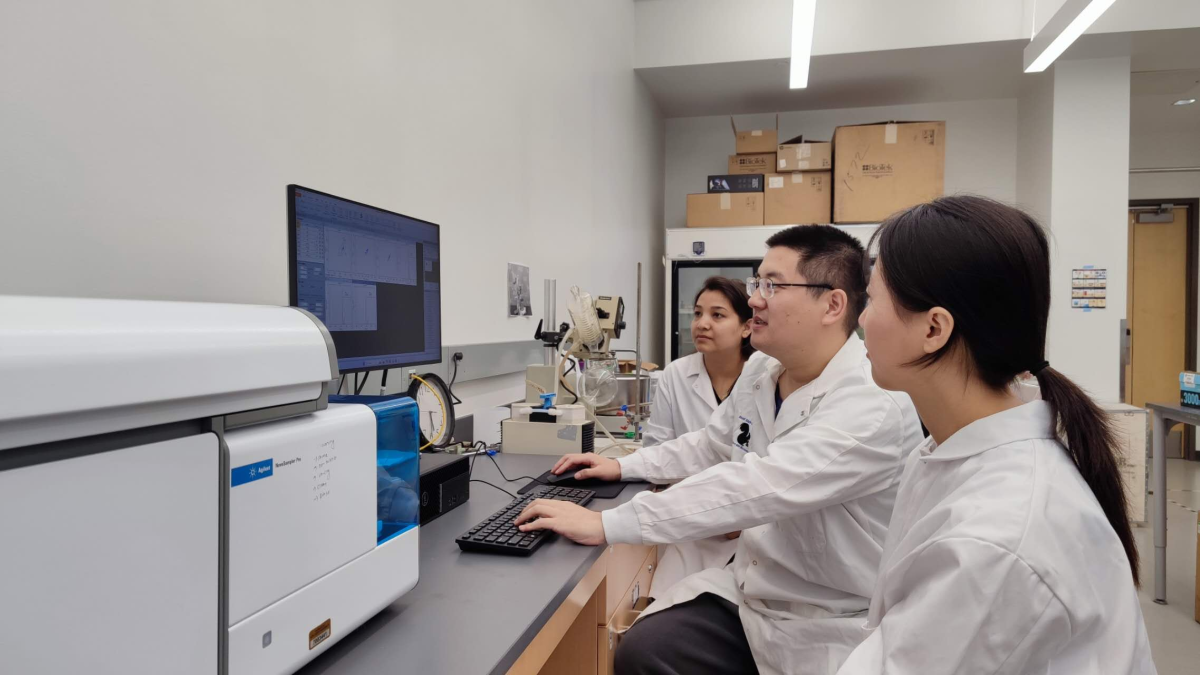
Graduate students Yiping Li (R) and Nita Shrestha (L) work with senior graduate student Jiahao Ji (center) to characterize micrometer-sized particles using a flow cytometer.
Training the Next Generation of Scientists
For students working in the Mao research group, this interdisciplinary environment provides opportunities to engage with research that crosses traditional boundaries between scientific fields. Students can gain experience with chemistry, biology, instrumentation, microscopy, spectroscopy, and instrumental analysis while contributing to research questions that have implications well beyond a single discipline.
Doctoral student Sajan Shakya said he finds working with the single-molecule instrumentation in his lab both challenging and rewarding.
鈥淭hese techniques allow us to observe molecular interactions and mechanical behaviors that are hidden in traditional ensemble measurements,鈥� he said. 鈥淏uilding and calibrating the instruments requires patience, precision, and creative problem solving, but the opportunity to investigate biological processes one molecule at a time makes the effort truly worthwhile.鈥�
The group鈥檚 work demonstrates one of the strengths of modern chemical research: some of the most interesting questions in chemistry occur at the boundaries between fields. By examining how physical forces influence molecules and biological systems, Mao and his research team are developing new ways to understand the chemistry of life.
鈥淚 believe this research is particularly important because it addresses a dimension of molecular biology that has been historically underappreciated,鈥� Mao said. 鈥淏y developing the techniques and conceptual language to study chemistry at the single-molecule level under realistic mechanical conditions, we open doors to understanding 鈥� and eventually intervening in 鈥� some of the most fundamental processes in biology.鈥�
鈥淭hat potential to bridge physical forces and molecular life is, to me, one of the most exciting frontiers in modern science.鈥�