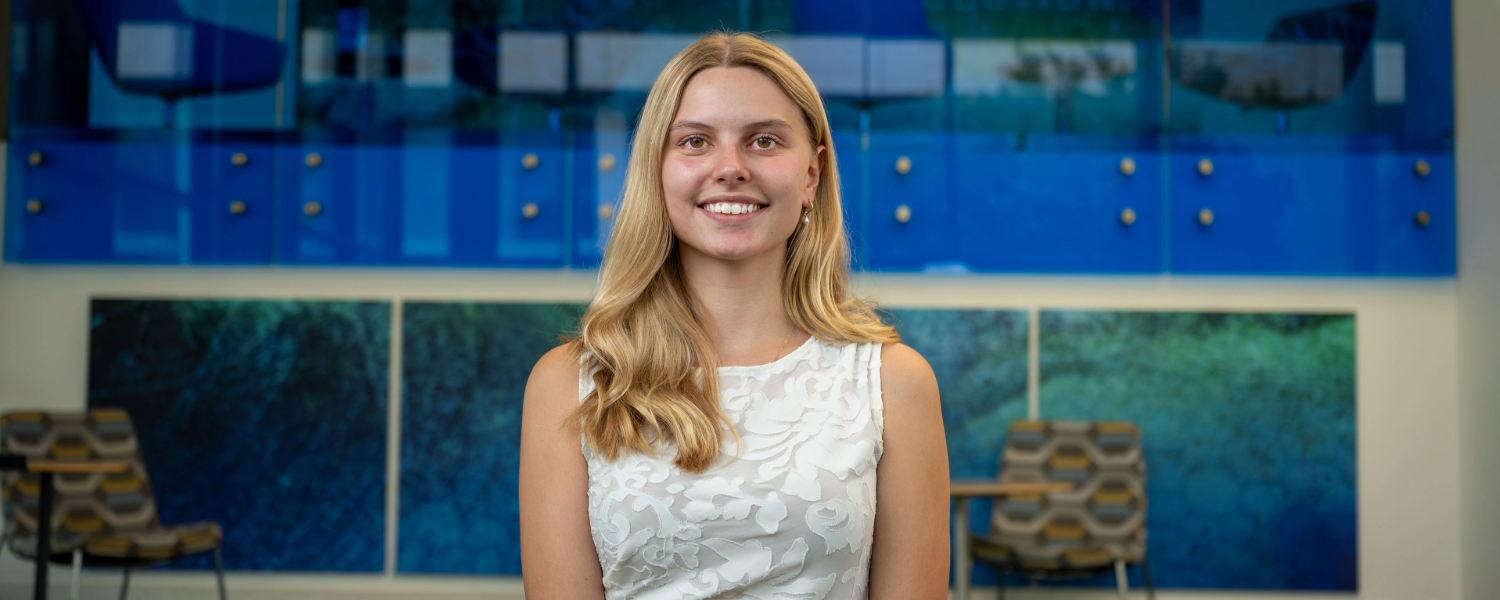
Kendall Myers has spent the past several years studying creatures that are easy to overlook.
At only about 3 millimeters long, ambrosia beetles are tiny enough to fit on the tip of a finger. Myers, however, discovered that these invasive insects possess a remarkable tool for doing significant damage to hardwood trees with mandibles containing unusually high concentrations of metals that help them bore into wood.
That research has now earned Myers national recognition.
Myers, a recent 麻豆精选 at Stark graduate, was named a 2026 Portz Scholar by the National Collegiate Honors Council, one of only four undergraduate students in the nation selected for the prestigious award.
Each NCHC member institution may nominate one undergraduate honors student for the Portz Scholars competition. Myers was selected as Kent State's nominee for her senior honors thesis examining metal deposition in the mandibles of invasive ambrosia beetles.
鈥淚 was honestly surprised to find out that my thesis was chosen,鈥� Myers said. 鈥淭here are a lot of people doing really cool and important research, so it was a very happy surprise to find out that I had been chosen as one of this year's Portz Scholars.鈥�
Created in 1990 to honor John and Edythe Portz, the Portz Scholars Award recognizes outstanding undergraduate honors research from colleges and universities across the country.
For Myers, the recognition represents the culmination of years of research that began when she was still a student at Chippewa Jr./Sr. High School and enrolled at 麻豆精选Stark through the College Credit Plus program.
A tiny beetle with a powerful tool
Myers' research focused on two species of invasive ambrosia beetles and how they are able to bore into hardwood trees.
These beetles create galleries deep inside trees, where they cultivate fungi that serve as their food source. Myers and her research collaborators wanted to understand how such small insects could use their mandibles to penetrate wood and contribute to damage caused by invasive species.
The answer involved metals.
Myers found that the portion of the beetles' mandibles that comes into contact with wood contains high levels of zinc, iron, copper and manganese. The metals increase the hardness of the mandibles, helping the beetles bore into trees.
The researchers also found that the beetles obtain the metals through their diet and must redeposit them into their mandibles each time they grow and shed their exoskeleton.
One specific finding caught Myers' attention.
鈥淥ne of the coolest moments was analyzing a specimen that had 30% zinc in its mandibles,鈥� Myers said. 鈥淢ost other insects that are known to have metals only have about 1-2%, so 30% is an extremely high value.鈥�
The discovery suggested the research could have implications beyond simply explaining how an invasive insect feeds.
鈥淚t solidified that we had found something really cool with some potentially important ecological impacts,鈥� Myers said.
That type of curiosity and her willingness to pursue questions that emerge from her research is becoming a defining part of Myers' undergraduate career.
鈥淭he thing that sets Kendall's research apart from others, and some of the main reasons for her to win this prestigious award, has to do with the rigor of her study, the questions she was asking were important to the field, and her writing skills made her research accessible,鈥� Matthew Lehnert, Ph.D. said. 鈥淭he mechanism for metal deposition in insect cuticles is still not understood. However, Kendall's research shed light on that subject.鈥�
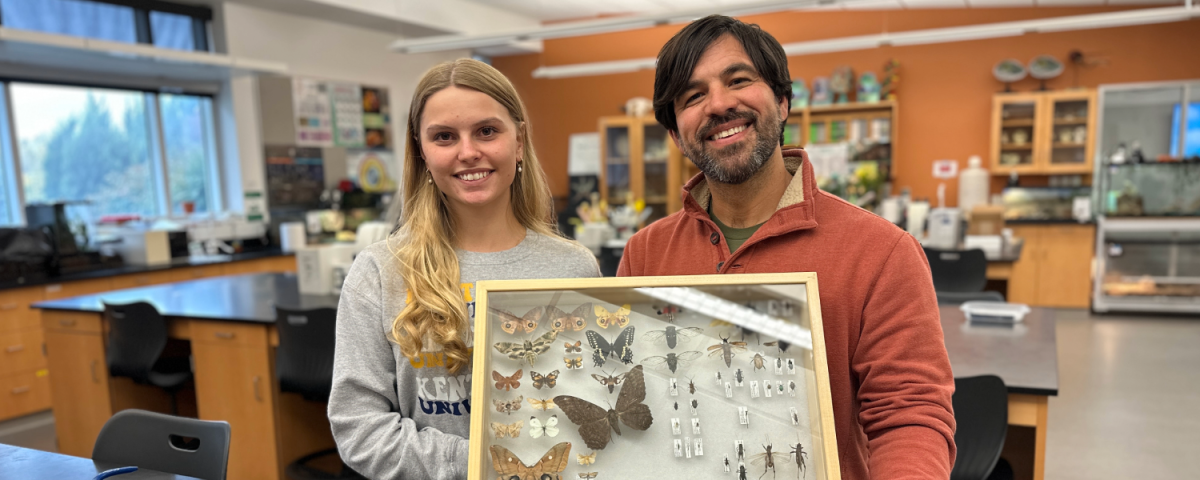
Lehnert, a professor of biological sciences at 麻豆精选Stark, served as Myers' research mentor and adviser throughout her undergraduate career. His mentorship played a significant role in Myers' decision to pursue research beyond her bachelor's degrees.
鈥溌槎咕nd the mentorship I received played a huge role in my experiences as a researcher and scientist,鈥� Myers said. 鈥淚 received nothing but support along the way, which encouraged me to continue to pursue research.鈥�
Myers said Lehnert's support was particularly influential as she considered graduate school.
鈥淒r. Lehnert's support and mentorship was a major factor in my decision to continue with research and go to graduate school,鈥� she said.
From her first microscope to national recognition
Myers' interest in insects developed after she joined the research lab at 麻豆精选Stark.
鈥淚 first became really interested in insects when I started in the research lab,鈥� she said. 鈥淪eeing them up close under the microscopes gave me a greater appreciation for how cool their biology is and how much can be learned from them.鈥�
The experience quickly turned into a passion.
鈥淎fter I started researching I kind of became hooked on it,鈥� Myers said.
Her research career at 麻豆精选Stark soon expanded beyond her honors thesis.
Earlier this year, Myers and Lehnert received international recognition in the 2025 Nikon Small World Photomicrography Competition. Their image, 鈥淗ook-like Crochets on the Larva of an Io (Automeris io) Moth,鈥� earned an honorable mention in the competition, which attracts thousands of entries from around the world.
Myers also presented her research at the Association of Southeastern Biologists annual meeting in Mobile, Alabama, where she earned the 2026 Oral Presentation Award in Animal Biology.
At Kent State's Symposium of Undergraduate Research and Experience and the Stark Campus Student Conference, she presented research on antlion respiration and mole cricket metal deposition, earning first and second place, respectively.
She also received the 2026 Departmental Award for the Honors Program and successfully defended her senior honors thesis, earning Thesis of Distinction.
Despite the growing list of accolades, Myers said her honors thesis remains the accomplishment for which she is most proud.
鈥淭he work I did on my thesis was a collaboration with a few other universities and other students, so it was really cool to see how we were all able to work together to collect the data that ultimately resulted in my thesis,鈥� she said.
The collaborative nature of the research also presented challenges.
Myers and her colleagues worked with two beetle species, multiple life stages, their food sources and the wood they bored into. The project generated a large amount of data that had to be organized and analyzed.
鈥淜eeping everything organized for proper analysis was a little challenging at times,鈥� Myers said. 鈥淚t took some trial and error with organizational methods to find something that ended up working out well in the end.鈥�
A foundation for what comes next
Myers' path to graduate school began at 麻豆精选Stark, where she earned dual bachelor's degrees in biology and psychology.
Starting as a College Credit Plus student gave her an opportunity to experience college and research before making the decision to attend 麻豆精选full-time.
鈥淭hat experience had a big impact on my decision to attend KSU Stark,鈥� Myers previously said. 鈥淚t allowed me to meet professors, get involved in research early and see what it's like to be a 麻豆精选student.鈥�
The Stark Campus' smaller classes and opportunities for undergraduate research provided a foundation for her academic career.
鈥淜ent Stark gave me the support and opportunities that have continued to push me towards success,鈥� Myers said. 鈥淭he smaller class sizes helped with my education in the classroom, and opportunities and support in the lab let me apply what I learned into developing significant research projects.鈥�
That foundation will continue into the next stage of her education.
Myers will begin a Ph.D. in biology this fall at Case Western Reserve University, where she plans to study butterfly and moth evolution, development and sensory systems.
For Myers, graduate school isn't a departure from the questions she explored at Kent State. Instead, it is an opportunity to pursue them further.
鈥淥ne of my big goals is to learn new methods that can help to answer more of the questions that developed as next steps from my research at Kent State,鈥� she said.
The research experience she gained at Stark has helped shape the direction of her future career.
鈥淚 think the research I've done at Kent has set me on the path I am on now,鈥� Myers said. 鈥淚 am looking forward to continuing to work with the teams I worked with at Kent.鈥�
From a 10-year-old fascinated by her first microscope to an undergraduate researcher earning one of the nation's highest honors for honors research, Myers' journey was always driven by a willingness to look closer.
Now, as a Portz Scholar and future Ph.D. candidate, she is preparing to keep asking questions, even when the answers may be found in places most people never think to look.