

The Environmental Science and Design Research Institute fosters innovative, interdisciplinary research at the intersection of natural, human and built systems. Our mission is to generate new knowledge, develop practical solutions and create transformative designs that address pressing environmental challenges鈥攍ocally, regionally and globally.
We champion research and creative activities grounded in scientific methods and design thinking. ESDRI brings together students, faculty and community partners to explore the complex relationships among biological, social, cultural and economic systems. These dynamics shape the availability of essential resources, support biodiversity and influence human health and well-being.

Students: The institute aims to build research skills in students, in order to cultivate well-rounded, critical thinking professionals. ESDRI recognizes the professional and personal importance of students having foundational research or creative experiences, professional skills, and environmental knowledge, which is facilitated through a variety of workshops, speakers, forums, special events, socials, one-on-one guidance, and more. The institute supports undergraduates through its Undergraduate Fellowship Program, in hopes of mentoring a new generation of scholars. ESDRI supports graduate students through its Graduate Student Awards. All students are encouraged to share their work at the ESDRI Research Showcase each Spring.
View Current ESDRI Fellows
Faculty: ESDRI provides many opportunities for faculty to advance their research and facilitates multidisciplinary collaborations, procuring intramural and extramural funding, and working with qualified student researchers. The institute engages a broad range of talented scientists, designers, and practitioners, spanning many academic disciplines, fields, and programs. The institute proudly hosts an annual Sustainability Forum, with an ever-evolving theme, which draws from KSU faculty, students, and many of our community partners.
Academic units represented within ESDRI include:
- Aeronautics and Engineering
- Architecture and Environmental Design
- Art
- Biological Sciences
- Chemistry and Biochemistry
- Communication and Information
- Earth Sciences
- English
- Fashion
- Geography
- Peace and Conflict Studies
- Political Science
- Public Health
- Recreation, Park and Tourism Management
- Teaching, Learning and Curriculum Studies
View ESDRI-affiliated Faculty Members
By empowering environmental research, the institute aims to foster change by drawing from robust, well-informed science and design or extrapolating on the research ourselves. ESDRI encourages students, faculty, and the greater community to understand and leverage the interacting geological, biological, human, economical, cultural, and social systems around us. These overlapping systems impact and regulate the availability of resources (e.g. pure water, clean air, and food), sustain diversity of life on Earth, promote well-being, and affect all of us in our daily life.
Connect with us
 @esdri_ksu
 www.linkedin.com/company/esdri


A team of 麻豆精选students took home the Outstanding Science Award from the Biodesign Challenge Summit 2020 held in June.
The words 鈥渂iology鈥� and 鈥渄esign鈥� might not typically intertwine; however, 麻豆精选鈥檚 Biodesign Challenge course was created to challenge the idea that the two separate disciplines could not collaborate.

When cities need help imagining new possibilities for their urban places and communities, they call 麻豆精选鈥檚 Cleveland Urban Design Collaborative (CUDC). Most recently, 麻豆精选architecture students had the opportunity to put the skills they learn in the classroom to make an impact on local communities in Erie, Pennsylvania.

麻豆精选鈥檚 Fashion School continuously finds ways to innovate. Its unique lifestyle boutique, Fashion School Store (FSStore), in downtown Kent recently added a new line called 鈥淪ustainability RETOLD.鈥� This collection includes sustainably made clothing, featuring work from five different students and three faculty.
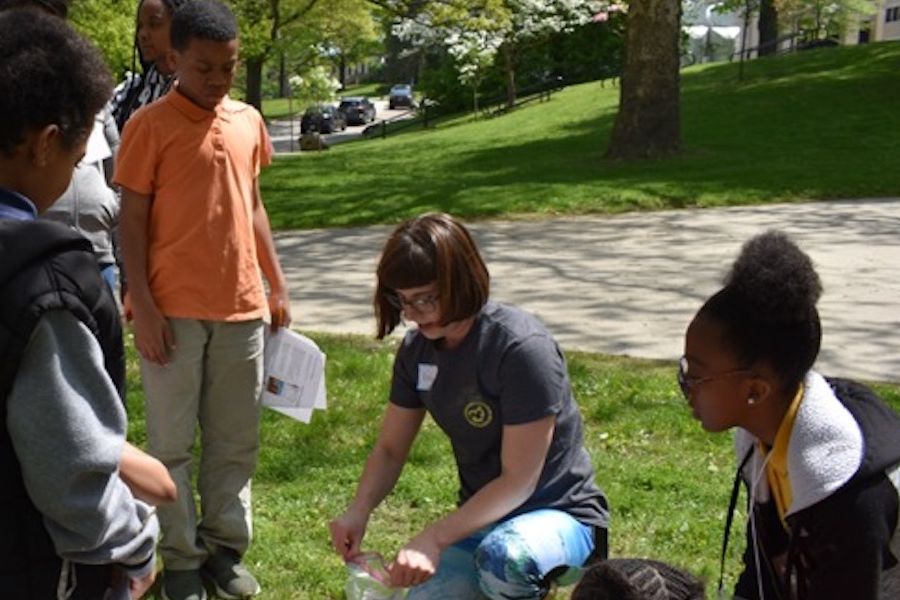
Bridget Mulvey, Ph.D., associate professor of science education in the College of Education, Health and Human Services; and David Singer, Ph.D., associate professor in the Department of Geology in the College of Arts and Sciences, recently merged real geology research with community service in an effort to show some Akron Public Schools students that science is not just a benefit to their community but a viable career option, too.

Emmaleigh Given recently spent three summers and two winters in a remote biological reserve in the middle of the rainforest in the Alajuela Province of Costa Rica, where she has and will spend several months conducting research on community ecology, and she has one more trip planned. Being hunted by unseen predators isn鈥檛 the way most researchers conduct their work. But for some, it鈥檚 just part of the day.

Though she had an interest in science at an early age, Raissa Mendonca had no idea she would end up over 4,000 miles away from her hometown of Recife, Brazil, studying and doing award-winning ecological research in the College of Arts and Sciences at 麻豆精选 in Kent, Ohio. She probably did not expect to be wearing a bug net over her head in Manitoba, Canada, either.

City rats are unlikely to be on anyone's list of favorite animals, but researching exactly how they are problematic for public health provided a unique opportunity this past summer for Gracen Gerbig, 麻豆精选junior majoring in Cellular and Molecular Biology.

Ecosystems in today's world are responding to a wide variety of environmental changes. What happens when these changes interact? That was the topic of a recent paper published by Dr.

At the 16th Annual CitiesAlive Conference recently held in New York City, a consortium of Ohio universities was selected as one of the first four North American regional centers of living architecture by