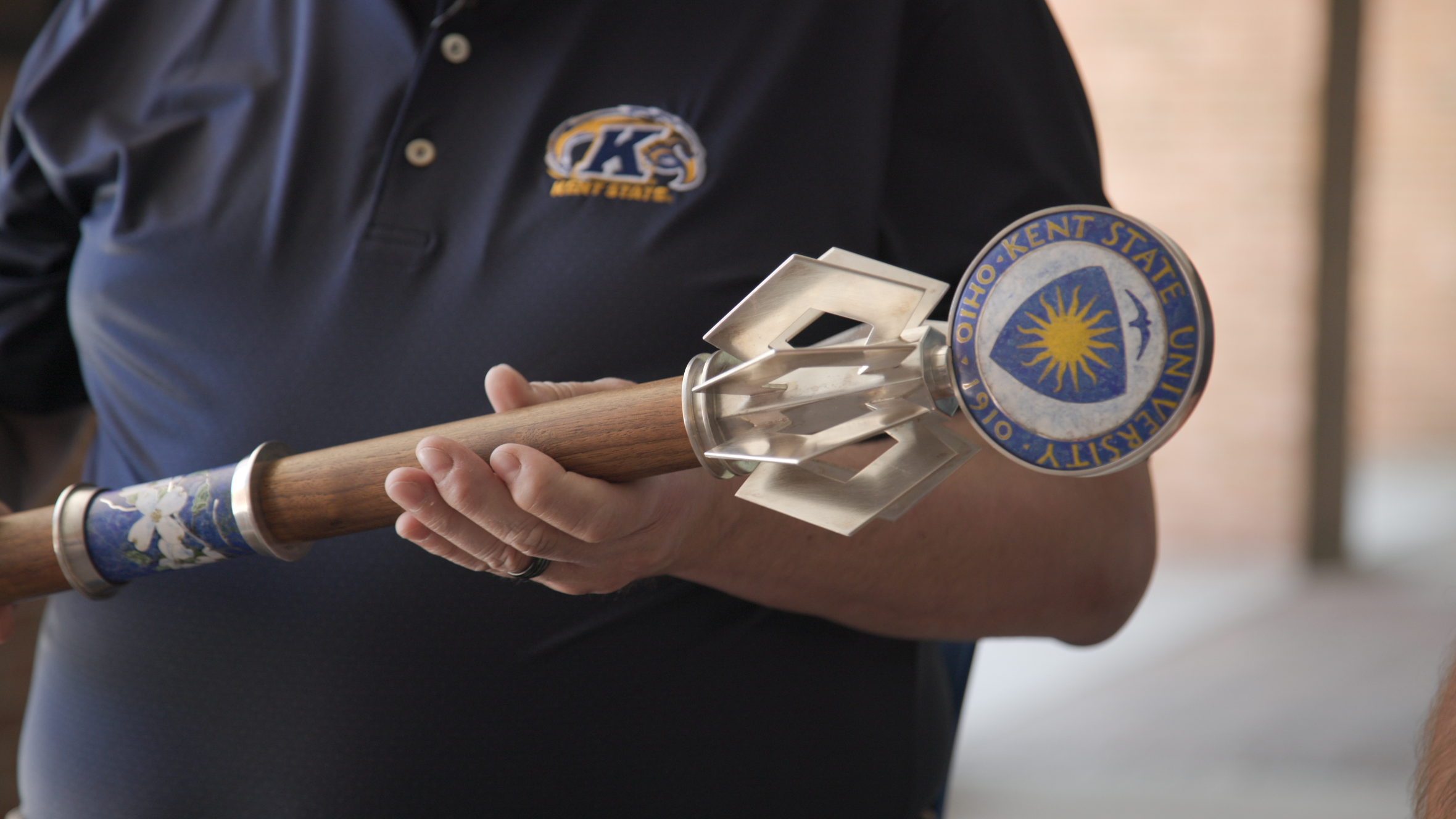
For nearly three decades, 麻豆精选's ceremonial mace has led thousands of graduates into commencement, symbolizing the authority, history and traditions of the university.
On Aug. 8, it also told a deeply personal story.
In 1998, Master of Fine Arts graduate Michael Jaszczak watched the ceremonial mace he designed and handcrafted make its debut during Kent State's 200th Commencement. Watching the graduation that day was his 8-year-old son, Dan.
Now, 28 years later, Dan Jaszczak is returning to 麻豆精选to celebrate receiving his Master of Music in Music Education, following the same ceremonial mace his father created.
"Now I get to be the parent in the audience when this gets brought in,鈥� Michael Jaszczak said. "And knowing that it's my son's actual commencement to get his master's degree, pride goes way over the top. It's hard to even describe that sensation and that feeling that I have."
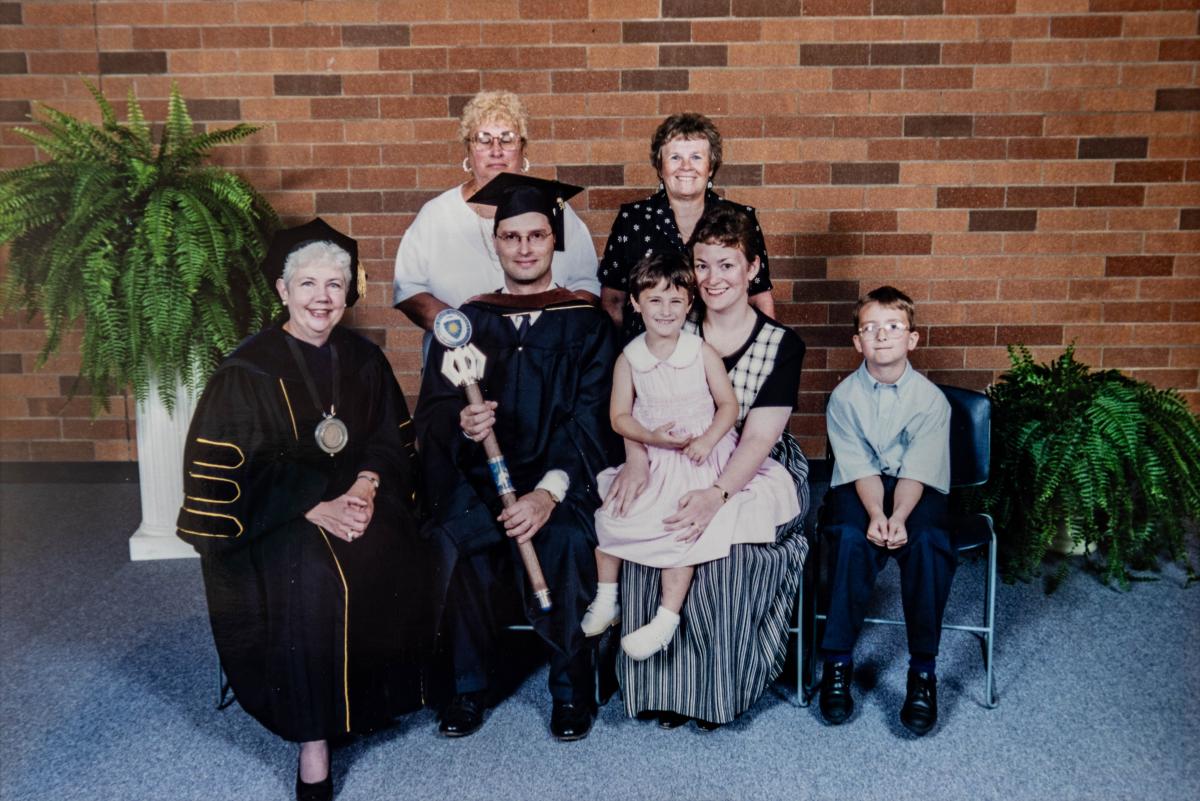
Adding to the significance is a photograph taken after the 1998 commencement ceremony, showing Michael and Dan Jaszczak, some family members, then-President Carol A. Cartwright and the newly unveiled mace. This year, the father and son hope to recreate that moment with 麻豆精选President Todd Diacon, bringing the story full circle.
An Opportunity Only 麻豆精选Could Provide
The story began in the fall of 1997 while Michael Jaszczak was completing his Master of Fine Arts degree in Kent State's School of Art.
His advisor, Professor Emerita Kathleen Browne, approached him about a university competition to design a new ceremonial mace.
At first, Michael Jaszczak wasn't sure he could take on another project.
"I was in my last year of my Master of Fine Arts program, and I was knee-deep in trying to work on these very difficult pieces," he said.
Then Browne offered encouragement that changed everything.
"She said, 'Of all the people I know, you have the ability to design it, engineer it and get it built in time for the 200th Commencement.' So I said, 'OK.'"
Michael Jaszczak submitted two designs, and the university selected one of his concepts.
Creating the mace became much more than another class project.
There aren't too many people that get a chance to make a ceremonial mace for a university because they're steeped in tradition," he said. "That was a real special thing that, for me, was the most impressive of all the things I could have ever had.
He added, "I got a chance to build this for my alma mater. And not only that, but it was going to be first used at my commencement ceremony. So everything fell in line. It was just a perfect thing."
Creating a Lasting Symbol
The ceremonial mace remains one of Kent State's most recognizable commencement traditions.
Created from walnut, metal and enamel, it incorporates symbols representing the university, including the university seal, a chimney swift, Kent State's blue and gold colors and eight flanges representing the university's eight-campus system.
Michael Jaszczak also designed the mace so future generations could preserve it.
"I try to build everything I do to what I would call a museum standard," he said. "If something does happen, it can actually be totally removed."
Seeing it again for the first time in 28 years brought back vivid memories.
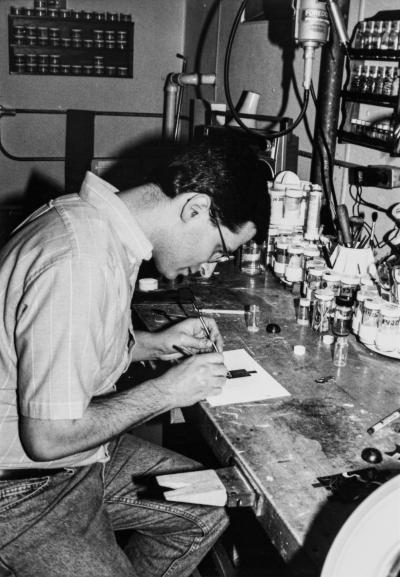
"I remember soldering every piece together in my little tiny, tiny studio at the time," he said. "I remember this section of the mace [the eight flanges] glowing red hot to get all of the solder joints to be just perfect."
Holding it again was emotional.
"There's very few times when you're actually somewhere and you see something that you made, especially so long ago, and you look at it and you say, 'Wow, I made that. I did that.'"
Growing Into the Story
Dan Jaszczak remembers attending his father's commencement in 1998, though not for the reasons he does today.
"It鈥檚 a big, boring ceremony that you have to sit through," he said with a laugh.
As he got older, however, his appreciation changed.
"I think my appreciation for it has just grown even more now that I'm an adult and I understand all of the pomp and circumstance and the tradition. And to be able to be a part of that 鈥� to have my dad be a part of that 鈥� is a pretty cool thing."
When Dan Jaszczak walks into commencement this year, he knows he'll notice something many graduates won't.
"I'm sure when I see it come down, I'll kind of give it an extra look and be like, 'I know where that came from.' Nobody around me sitting will probably know me or know who my dad is, but I'll know. And I'm sure that that's going to be a pretty cool feeling."
Recently, Dan Jaszczak had the opportunity to hold the mace for the first time.
"I can picture him in his studio, hunched over, just doing the work," he said. "It's pretty cool."
A Legacy Carried Forward
Over the years, Michael Jaszczak has been reminded that his work has become part of 麻豆精选history.
"I can't tell you how many times somebody from my community or somebody from the school [where I worked], a student went to his brother's or sister's commencement at Kent, or a parent would come up at an open house and say, 'I had just gone to a commencement at Kent. Did you make that mace? I thought I heard them say your name?'"
Now, the tradition has come home to his own family.
For Dan Jaszczak, watching the mace lead his commencement means more than witnessing a university tradition.
"I look up to my dad a ton," he said. "I feel like he's done so many amazing things that I hope I can do half of the cool stuff that he's done over the years."
Then he reflected on just how unusual his father's accomplishment really is.
"I always have to force myself to kind of take that step back and know, not everybody gets to do this. Not everybody can say that they designed and built the ceremonial mace for their alma mater."
As another class of 麻豆精选graduates prepares to cross the stage, the ceremonial mace will once again lead the academic procession.
For most, it represents the traditions of the university.
For Michael and Dan Jaszczak, it also represents 28 years of 麻豆精选history, craftsmanship and family 鈥� and a reminder that the traditions created on one commencement day can inspire another generation.